Before you give an AI shopper another coupon, check whether they can use the benefits they already have.
Your store could be the better deal for an existing customer and still lose the comparison. A member price, free-shipping entitlement or available reward may change what that customer would actually pay. If an assistant compares only public offers, that value may never enter the decision.
A small example changes the ranking
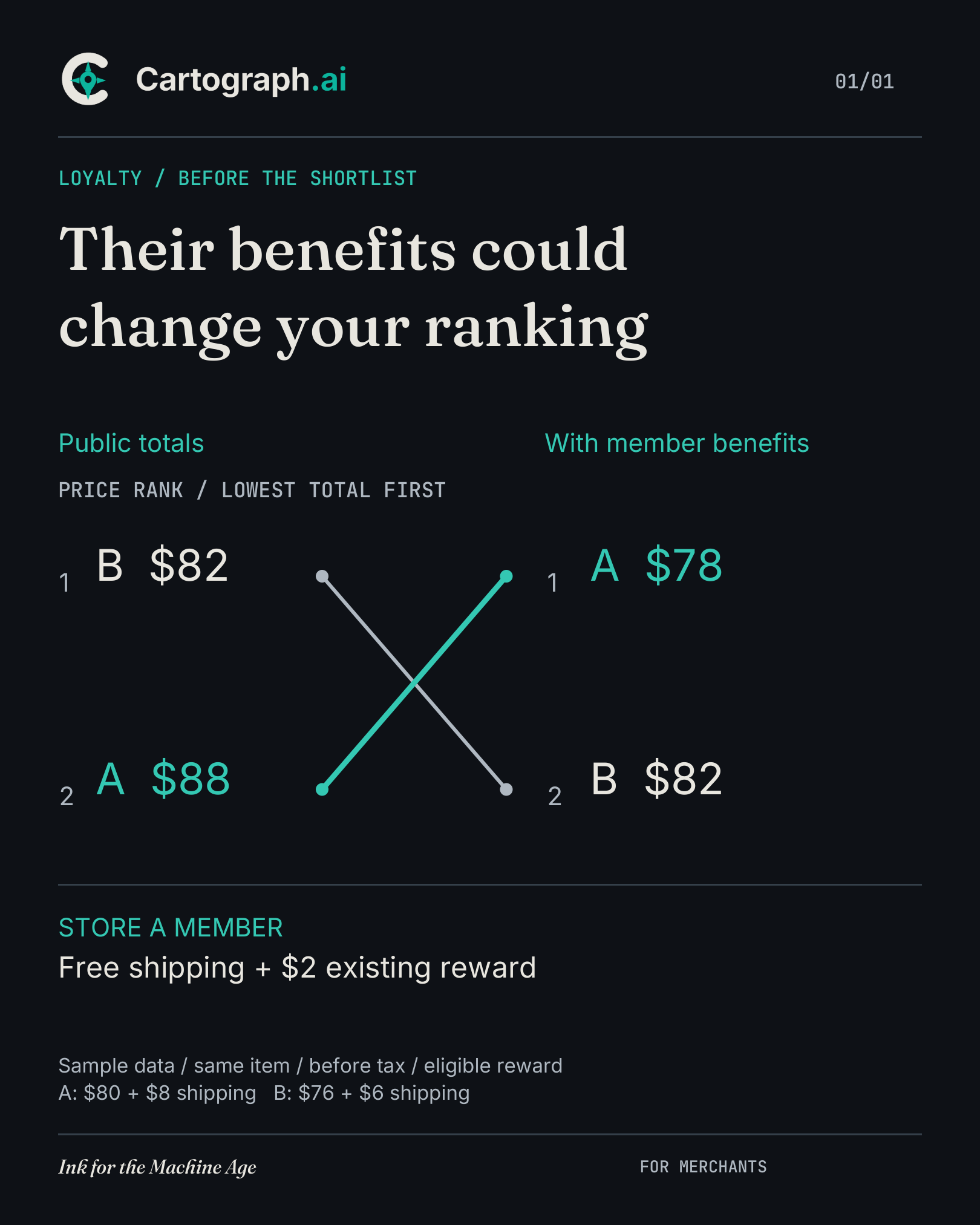
Consider the same item at two stores. This is a hypothetical price comparison in U.S. dollars, before tax:
- Store A: $80 for the item, plus $8 shipping. Public total: $88.
- Store B: $76 for the item, plus $6 shipping. Public total: $82.
An assistant sorting those totals from lowest to highest would put B first.
But suppose the customer is already a member at A. They qualify for free shipping and have a $2 reward that is valid and redeemable on this order. Their total at A becomes $78.
The price ranking changes without A issuing a new discount. This does not make A the best choice on every dimension; delivery, returns and the customer's preferences still matter. It shows how leaving out an existing benefit can produce an incomplete comparison.
It also matters that the $2 is available to spend now. Points earned for a future purchase should not be presented as an immediate reduction in today's amount due.
There is interest in delegation, not proof of adoption
In PYMNTS Intelligence's July 2026 report, commissioned by Visa Acceptance Solutions, 51% of surveyed consumers said they would let an AI agent manage loyalty programs. The consumer survey covered 5,241 adults across the United States, Brazil and the United Arab Emirates. [1]
That is stated willingness in those markets, not evidence that half of consumers already delegate their loyalty accounts.
My read is that loyalty teams should examine when a benefit becomes visible, alongside how generous it is. A reward first discovered at checkout cannot help win an earlier comparison if the shopper has already gone elsewhere.
Some benefits can already appear earlier
Google's Merchant Center loyalty feature lets eligible merchants surface benefits including member pricing and shipping perks. Its current documentation also says loyalty benefits are eligible to appear in AI Mode and Gemini Apps in the United States. Availability and the shopper experience vary by country and surface. [2]
That is a useful, concrete place to start checking your own setup. It is not evidence that every assistant can recognize a customer's membership, retrieve their individual reward balance or redeem it.
A published member offer and permission to use a particular customer's account are separate questions. Both need an answer before the example above can work in practice.
Make the benefit recognizable and usable
I would work through three questions with the loyalty, commerce and customer-account teams.
What can the shopper learn before signing in? Make the program's general terms clear: eligible products, tiers, shipping thresholds, exclusions and expiry rules. A statement such as “members get free shipping” is incomplete if the customer's basket or destination does not qualify.
What can be confirmed with the customer's permission? Use the supported account and authorization flow to establish the applicable entitlement. Knowing that an assistant requested a page does not establish which customer it represents or what that customer authorized. Keep personal account details and credentials out of public product data and analytics exports.
What survives into checkout? Verify that the basket, membership and applicable benefits produce the expected total. If a reward expires, an item is excluded or an offer cannot be combined with another promotion, make the change clear before the customer commits.
Coupons need the same discipline. “10% off” is not a complete price when exclusions, minimum spend or delivery costs alter the result.
Test one real benefit before expanding the program
Start with one existing benefit and a small set of eligible products. Check what the chosen AI shopping surface displays before a merchant visit, then test any supported handoff into checkout. Record unsupported steps as limitations. Use authorized test accounts to compare the same basket for the same delivery destination as a guest, as an eligible member and as a member who does not meet the benefit's conditions.
At each step, record the terms shown, the eligibility result and the total actually accepted at checkout. Include failed eligibility and, where applicable, an offer-stacking restriction. The useful result is an explainable difference between those journeys, rather than a successful redemption alone.
This builds on the same principle as our cart-transfer analysis: carrying the product forward is only part of preserving the customer's expected deal.
Keep the customer relationship separate from the referral channel
An existing member returning through an AI assistant is still an existing member. The channel may be new; the relationship may be years old.
Where your authorized customer records support it, distinguish first-time and returning purchasers, then segment each by loyalty status. Membership alone does not establish a prior purchase. Otherwise, you risk paying an acquisition incentive to a returning buyer because the referral channel looks new.
Keep the attribution limits visible, too. An AI-referred visit does not by itself prove delegated shopping, and an unlinked order should not be assigned to an agent by guesswork. Our guide to AI referrals and agent activity explains that distinction.
For a loyalty test, I would watch repeat purchases and contribution after incentives, shipping and returns, alongside whether the expected benefit was actually applied. Existing rewards and free shipping still have an economic cost, even when no new coupon is issued. Use a comparable baseline or controlled test where practical before claiming that the change generated additional profitable orders.
The immediate opportunity is to make the value you already offer available to the customer's decision. Before increasing the incentive, ask a simpler question: are you losing on price, or because the customer's actual price never entered the comparison?
Source [1] methodology: Consumer survey fielded March 2026; 5,241 adult respondents across the U.S., Brazil and UAE. Checked October 16, 2026.
Adapted and expanded from Cartograph's LinkedIn post published October 16, 2026.