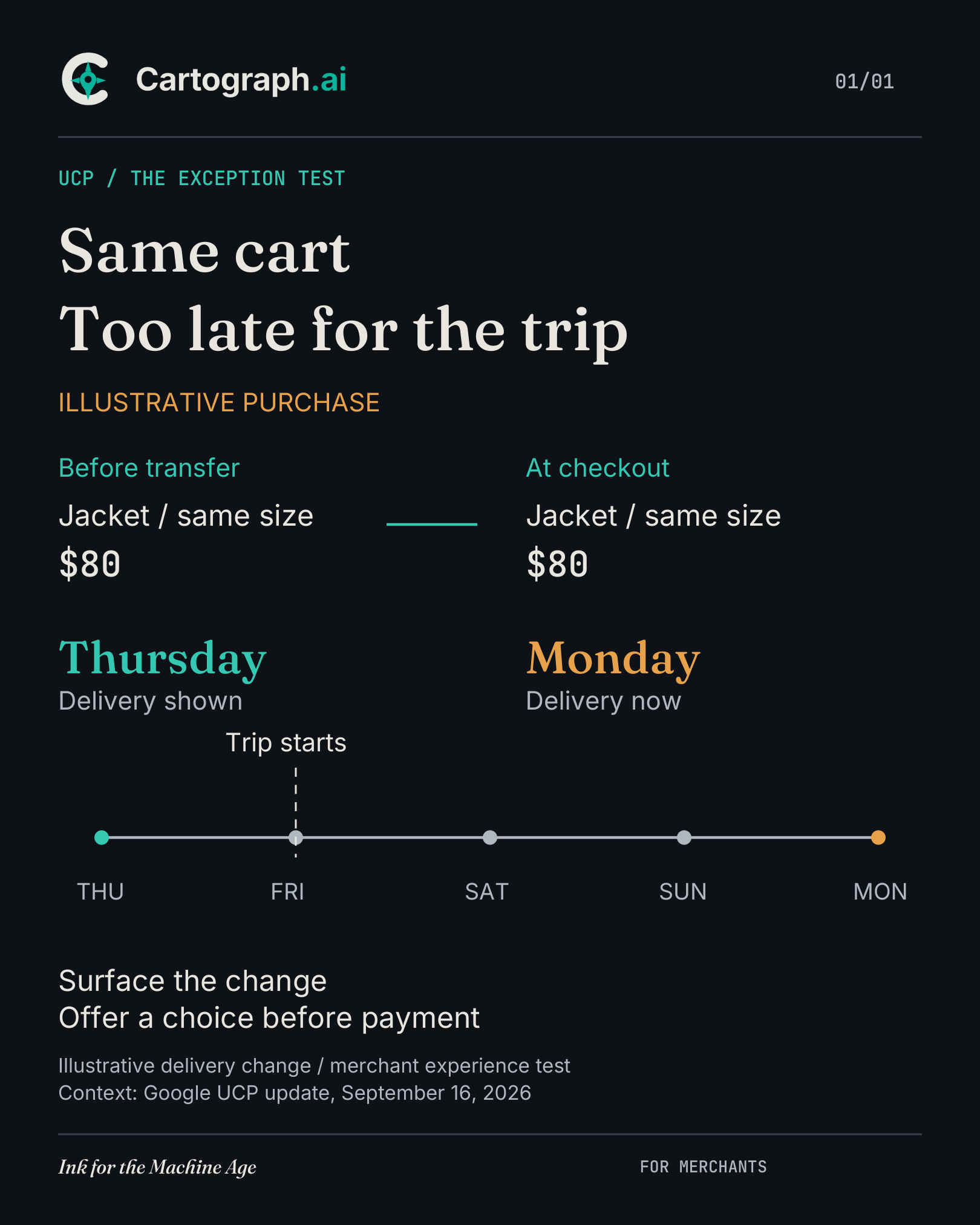
A shopper chooses a jacket for a Friday trip. The size is right, the price works, and the delivery estimate says Thursday.
They move from the AI shopping experience to the retailer’s checkout. The same jacket appears. So does the same price. But delivery is now Monday.
The cart transferred. The purchase no longer makes sense.
That is the test I would put in front of a merchant reviewing Google’s September Universal Commerce Protocol updates. Getting the integration working matters. So does checking what happens when the terms that made an item worth buying change along the way.
What Google announced
Universal Commerce Protocol, or UCP, is an open standard that lets agents and commerce systems work together. Google’s September 16, 2026 announcement adds cart transfer to a merchant site and enhanced checkout testing through its Merchant Center UCP integration hub. The announcement describes a gradual U.S. rollout, with Australia and Canada to follow early next year. [1], [2]
Google says UCP already enables direct checkout for hundreds of thousands of brands and retailers across Google. That describes availability, not completed orders or customer satisfaction. The September announcement also lists analytics as coming soon; it should not be read as confirmation that every merchant already has those capabilities. [1]
Google’s onboarding guidance describes a sandbox for validating the UCP profile, cart transfer and native checkout APIs. Merchants using a third-party platform or provider should check that provider’s integration plans. [2]
I welcome the emphasis on testing. My recommendation is to use it to examine the exceptions, too.
The item is only part of the decision
Retailers already deal with price changes, stock shortages and delivery estimates. None of that started with AI shopping.
What deserves closer attention is the handoff between the place where a shopper considers an offer and the place where they complete it. If those are different systems, the retailer may receive the product selection without knowing which detail made it acceptable.
For one customer, Monday delivery is fine. For the customer leaving on Friday, it defeats the purchase.
We should not assume UCP transmits every personal requirement or gives the merchant access to the shopper’s earlier conversation. Nor should a retailer need that conversation to notice that its delivery estimate changed.
The practical starting point is narrower: compare the terms your systems actually supplied with the terms available at checkout, wherever your implementation lets you observe both. When you cannot see the earlier terms, record that limitation rather than reconstructing what the shopper must have seen.
Test what happens when one thing changes
Start with a small set of products and a controlled test environment. Have your ecommerce team, agency or integration provider establish a working handoff, then change one condition at a time.
Delivery timing. Move the estimated arrival date beyond the date in your test scenario. Does the new estimate appear prominently before payment? Can the shopper consider faster shipping or another item without rebuilding the whole order?
Total price. Change a shipping charge or let a promotion expire. Is the new total clear? If the earlier offer is no longer valid, does the experience explain that change rather than leave the shopper to discover it at the last step?
Availability. Make the selected variant unavailable. Does the system preserve the other choices? If it offers a replacement, does it clearly distinguish the new size, color or product from the original selection?
For the jacket example, switching to a different size just to complete the order would not be a useful recovery. Neither would offering cheaper shipping that still arrives after the trip.
These are customer-experience tests I recommend, not additional requirements I am claiming UCP mandates. Run them alongside the protocol and platform’s required validation.
Measure the change and the recovery
A checkout completion rate tells you how many observed attempts ended in an order. On its own, it does not explain why the others stopped.
For a pilot, I would ask the team to record which observable terms changed, whether the change was surfaced before payment, whether an alternative was offered, and whether the shopper continued. Keep technical failures separate from valid changes to the offer: an unavailable item is not the same problem as a failed request.
There is another distinction worth preserving. A shopper who leaves after seeing Monday delivery may be making a sensible decision. Calling that a broken checkout would send the team looking for the wrong fix.
The useful question is whether the experience handled the changed offer clearly and gave the customer a workable next step. Depending on the situation, that could mean a different delivery option, another product, or an honest explanation that the store cannot meet the need.
Do not interpret a stop as proof of motive. Without feedback or a controlled test, you may know that delivery changed and the session ended, but not that one caused the other.
What I would ask before expanding a pilot
Can we identify the terms our own systems supplied? Can we detect meaningful changes before payment? Can the customer review those changes without losing the choices that are still valid?
Those questions are useful even when visibility into the earlier AI experience is limited.
At Cartograph.ai, our focus is merchant-side evidence: what can actually be observed on the merchant’s properties and connected systems. That evidence should help a team distinguish an integration failure from an offer change or an unanswered question. It should not pretend to reveal an off-site conversation we cannot see.
UCP is welcome progress in connecting commerce systems. The merchant’s acceptance test should still reach beyond whether the right items arrived in the cart.
For that Friday traveler, the jacket was never the whole order. Getting it in time was part of the deal.