If an AI agent visited your store today, would you know what it did?
Could it find the product it needed? Did it add anything to a cart? Did it run into a problem at checkout? Was there a sale?
In shopping, an AI agent is software that can take actions for a shopper, such as finding products or building a cart. For a merchant, the useful question is what happens when that software reaches your store. A report showing more “AI traffic” doesn’t answer that on its own.
I want to know whether that activity gives you something to act on: a product getting attention, a checkout problem to fix, or an order you can connect to the visit.
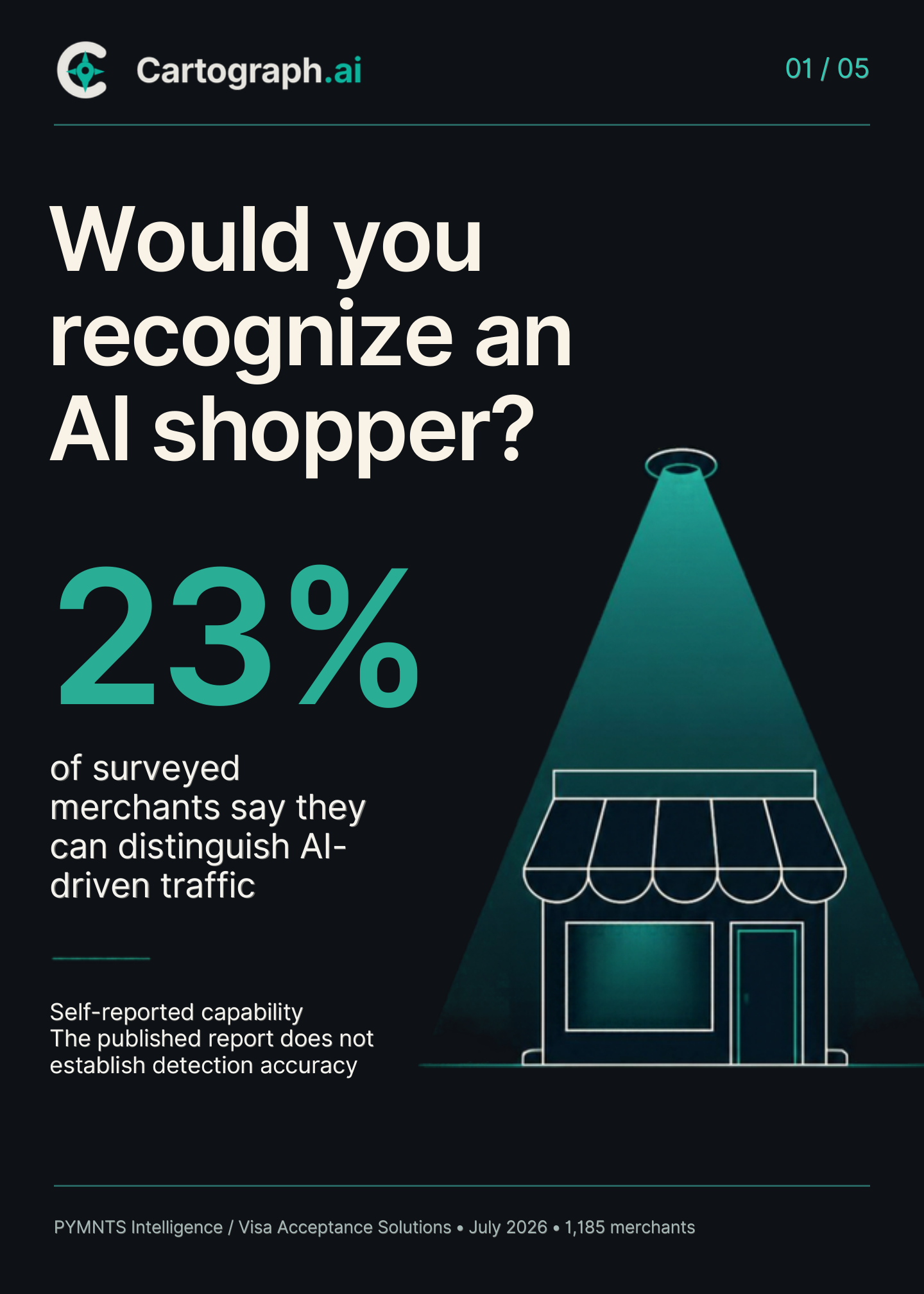
In the July 2026 Agentic Commerce Deep Dive, PYMNTS Intelligence and Visa Acceptance Solutions reported that 48% of surveyed online shoppers used AI to research their most recent purchase. Separately, 23% of surveyed merchants said they could identify AI-driven traffic and purchases. The research covered the United States, Brazil, and the United Arab Emirates.[1]
I’d be careful with that 23%. The merchants said they could do it; the published report does not provide a test of how accurately they do it. And a shopper using AI for research doesn’t necessarily mean an agent visited a store or made a purchase. Neither figure tells you how much of your own business comes from AI.
What does your “AI traffic” number actually mean?
Imagine three visits to your online store: a customer arrives through a link from ChatGPT, a crawler for an AI service collects your product details, and a shopping agent tries to add a product to a cart.
All three involve AI, but they tell you different things about a possible sale. Collecting product information, for example, does not prove someone is considering a purchase.
Ask your provider to explain what goes into its AI traffic number:
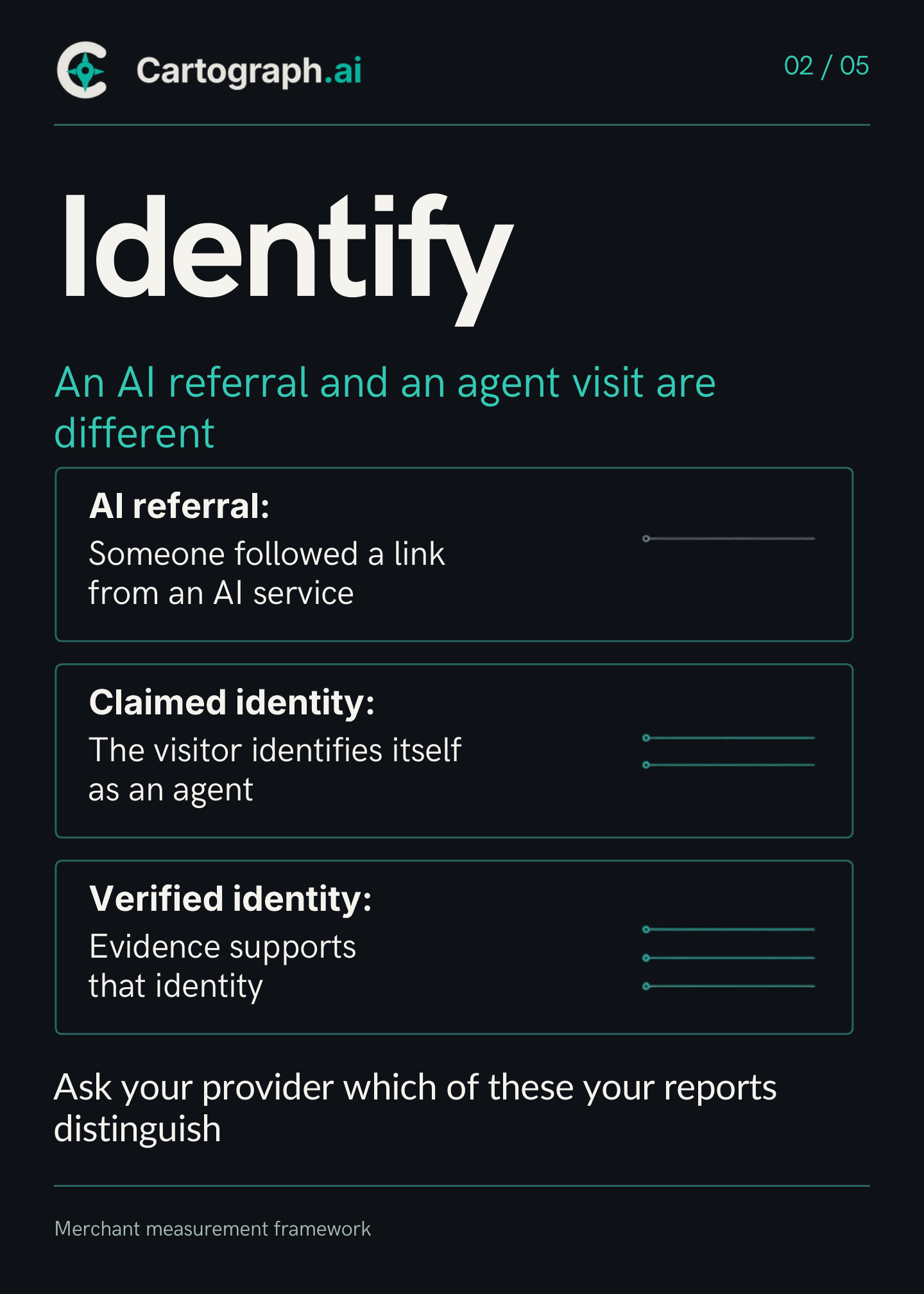
- Did someone follow a link from an AI service? That tells you where the visit came from. It doesn’t establish who is doing the shopping.
- Did the visitor identify itself as an agent? That is a claim your provider needs to check.
- Was that identity checked? Ask how the provider confirmed which bot or agent it was.[2]
These answers can overlap. A visit can come through a link and also have its identity checked. The point is to understand what your report can tell you before you use it to make a decision.
Your store’s records also won’t tell you everything happening inside an AI service. An agent accessing a product page does not prove it recommended that product to a customer.
Where can you check?
Start with the person or company that manages your website. That might be your agency, website host, or analytics provider. You don’t need to know how the tracking works to ask what it can show you.
Ask them to find one recent visit they believe came from an AI agent and answer three questions:
- Which products or pages did it access? Your host or website security provider may have that information.
- Did it successfully add anything to a cart or reach checkout? Your store platform or analytics setup may record those steps.
- Can you connect an order or an error to that same visit? This is where you find out whether the different systems can piece the visit together.
Also ask whether they are showing you all the recorded activity or just a sample. Some reporting tools, including Cloudflare’s Bot Analytics, use samples.[3] A summary chart may not contain enough detail to explain an individual visit.
Your domain or DNS provider can be a starting point if it also manages your website. Registering your domain alone does not give it access to your checkout activity.
If your provider can’t answer, ask what is missing. You may need more tracking, or simply a way to connect information you already have.
What would a useful answer look like?
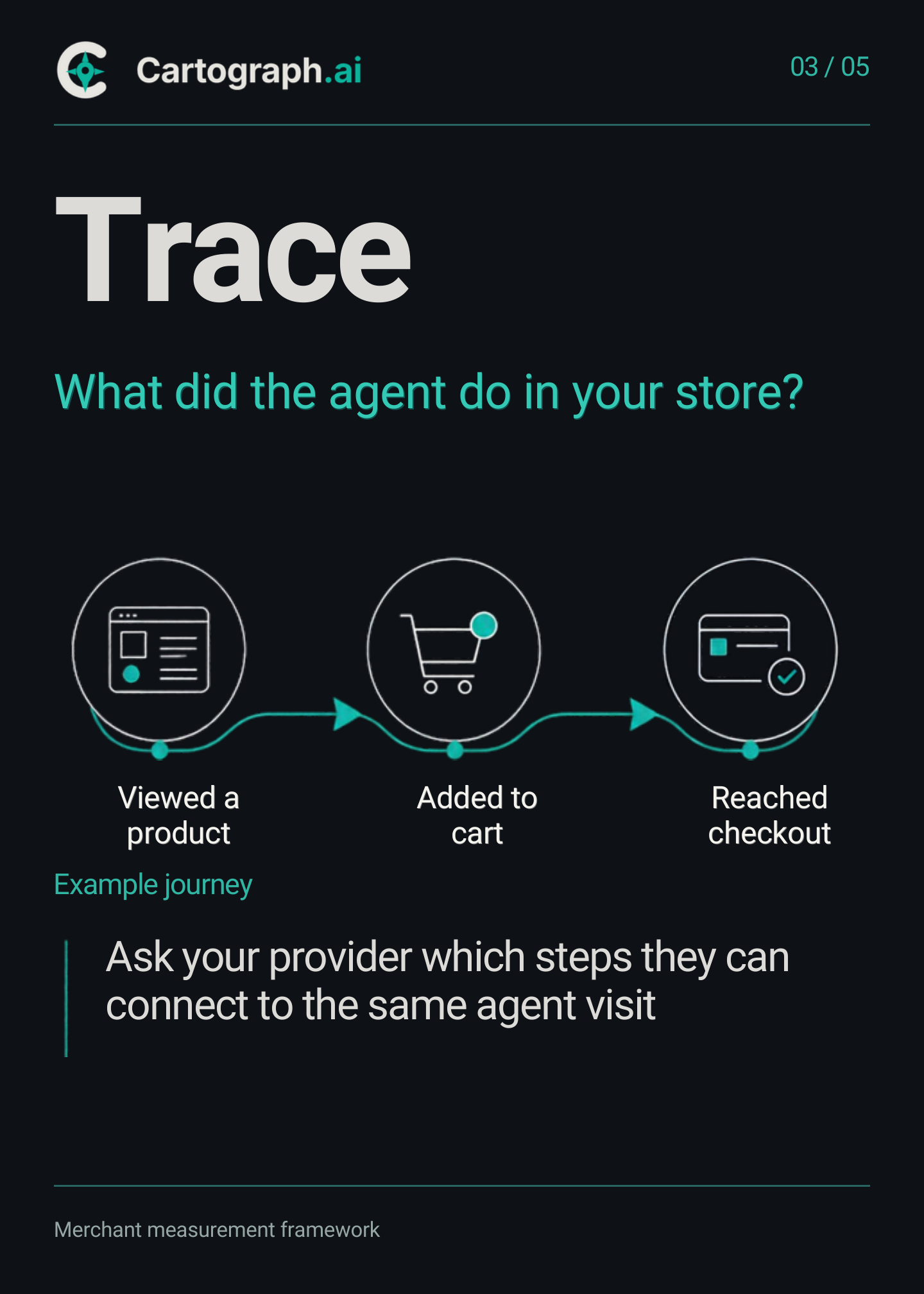
Here’s a hypothetical example: an agent accesses a product page, adds the product to a cart, and receives a message that shipping isn’t available.
If your team can confirm those steps belong to the same visit, you have something specific to investigate. Was the delivery address unsupported? Was a shipping rule wrong? Did the checkout fail to accept information the agent supplied?
You still need to find the cause, but you know where to start.
Ask what actually succeeded, too. Trying to add a product is different from adding it successfully. Reaching checkout is different from placing a paid order.
If the only thing your provider can show is a product page request, it cannot tell you that shipping caused a lost sale. That would be a guess.
The agent may stop while the customer keeps shopping
The same PYMNTS research found that 56% of surveyed consumers would let an agent search and compare products, while 35% would allow access to saved payment details.[1] These are preferences people reported, not a record of how they actually checked out.
Still, they give merchants a reason to consider what happens when a person takes over.
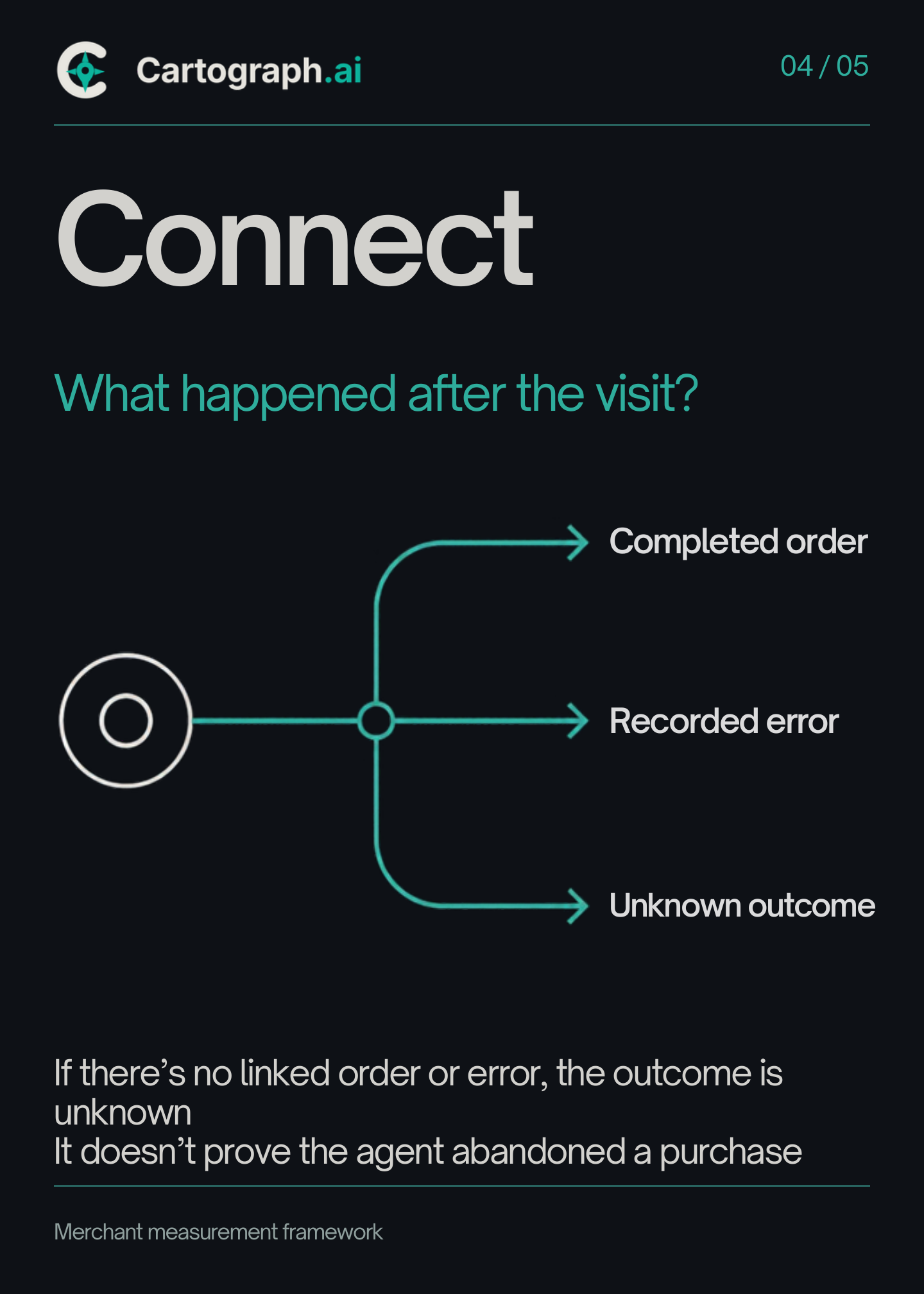
Suppose an agent builds a cart and the customer completes the purchase. If your reports lose that connection, you could see an agent visit with no sale and a separate customer order. You might conclude the agent traffic isn’t valuable when your reporting simply missed part of the journey.
That doesn’t mean every unfinished agent visit led to a sale. A recorded error tells you something went wrong at that step; it doesn’t tell you whether the customer later bought. Without a connected order, you may not know whether the visit ultimately resulted in a purchase.
A better report can look like better sales
There is one more thing I’d watch before making decisions from these numbers.
If your provider gets better at connecting orders to agent visits, your reported AI sales could increase even though your store hasn’t sold anything extra. You are seeing more of the business you already had.
So when the numbers move, ask: Did buying behavior change, or did the way we track it change?
That matters when deciding where to put your budget. Recognizing more existing orders is useful, but it isn’t the same as bringing in new ones.
Start with one visit
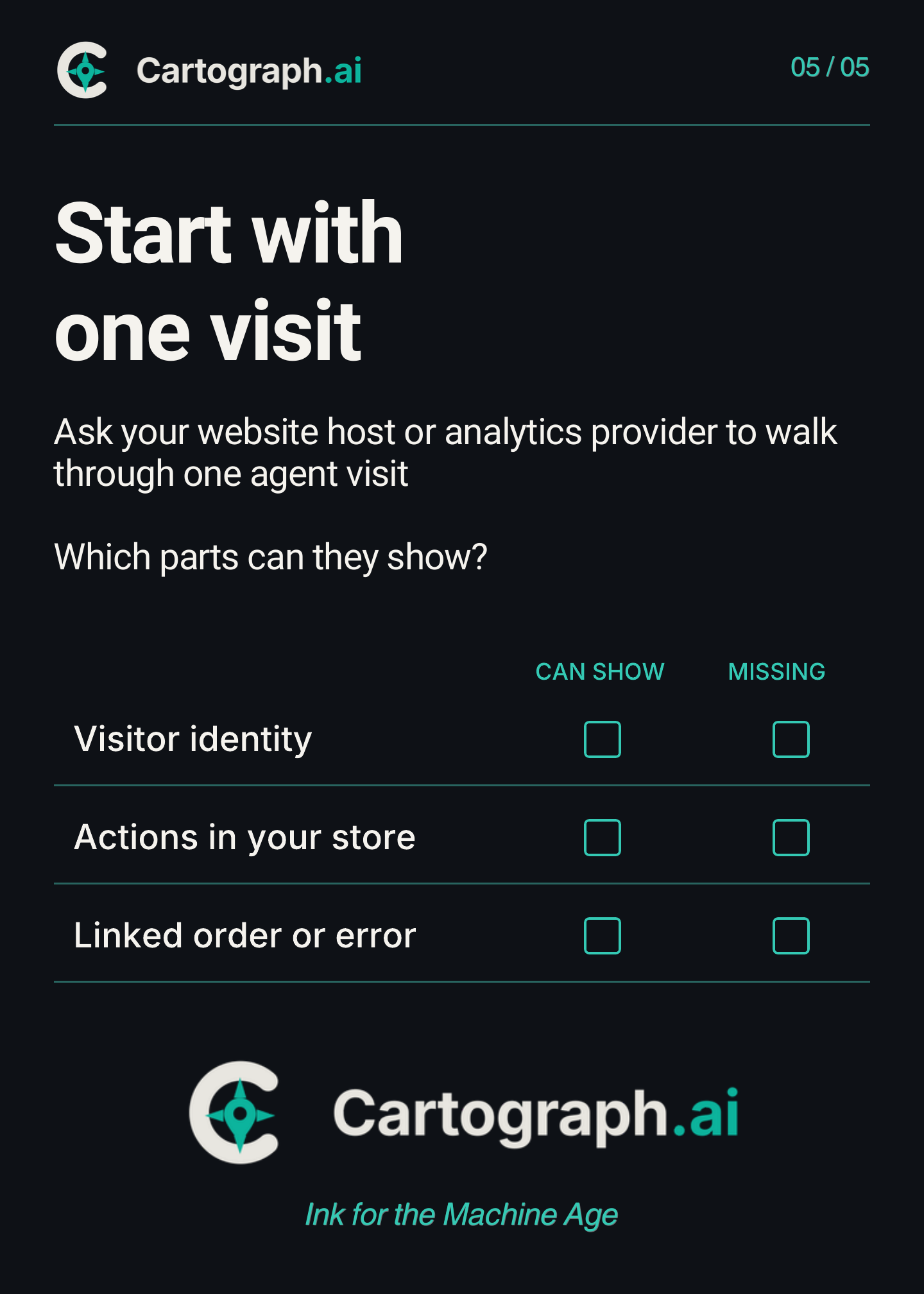
Here is the request I would send to your website team:
Show me one AI agent visit. How do we know it was an agent? What did it do in our store? Can we connect it to an order or a recorded problem? What can’t we tell yet?
You might find something to fix at checkout. You might discover that your systems each hold part of the answer. Or you might learn that your current reports cannot tell you much beyond “AI traffic went up.”
This is why I’m building Cartograph.ai: to help merchants understand which agents reach their stores, what they do, and what happens next.
Before spending more to attract AI shoppers, I’d want to understand what happens to the ones already reaching the store.